Matt Osborn
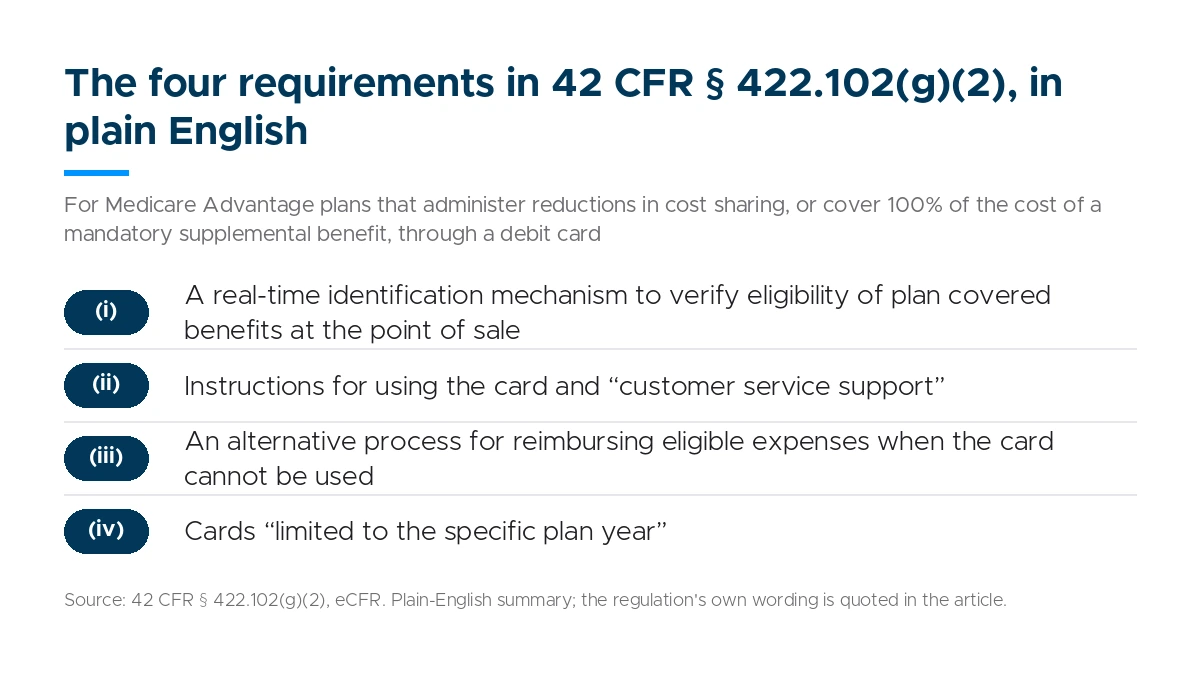
Medicare Advantage (MA) plans that administer reductions in cost sharing, or cover 100% of the cost of a mandatory supplemental benefit, through a debit card must meet four requirements, set out in 42 Code of Federal Regulations (CFR) § 422.102(g)(2). The first is a real-time identification mechanism that verifies eligibility of plan covered benefits at the point of sale (the register). The rule took effect June 1, 2026, and applies to coverage beginning Jan. 1, 2027, according to the Federal Register.
Key takeaways
- What it requires: four duties, starting with a real-time identification mechanism to verify eligibility of plan covered benefits at the point of sale. Source: 42 CFR § 422.102(g)(2).
- Two dates: effective June 1, 2026; applicable to coverage beginning Jan. 1, 2027. Source: Federal Register, FR Doc. 2026-06600.
- Two scope conditions: the plan chooses whether to use a debit card, and the requirements cover reductions in cost sharing or 100% of the cost of a mandatory supplemental benefit. Sources: CMS’s final rule, Table 1 and 42 CFR § 422.102(g)(2).
What does CMS’s Contract Year 2027 rule require of supplemental benefit debit cards?
Four things, listed in 42 CFR § 422.102(g)(2)(i) through (iv). Paragraph (i) reads: “Provide debit cards that are electronically linked to plan covered items and services through a real-time identification mechanism to verify eligibility of plan covered benefits at the point of sale.”
The other three, in plain English:
- Plans must give enrollees instructions for using the card and “customer service support.”
- Plans must have an alternative process for reimbursing eligible expenses when the card cannot be used.
- Cards must be “limited to the specific plan year.”
When does the debit card requirement take effect?
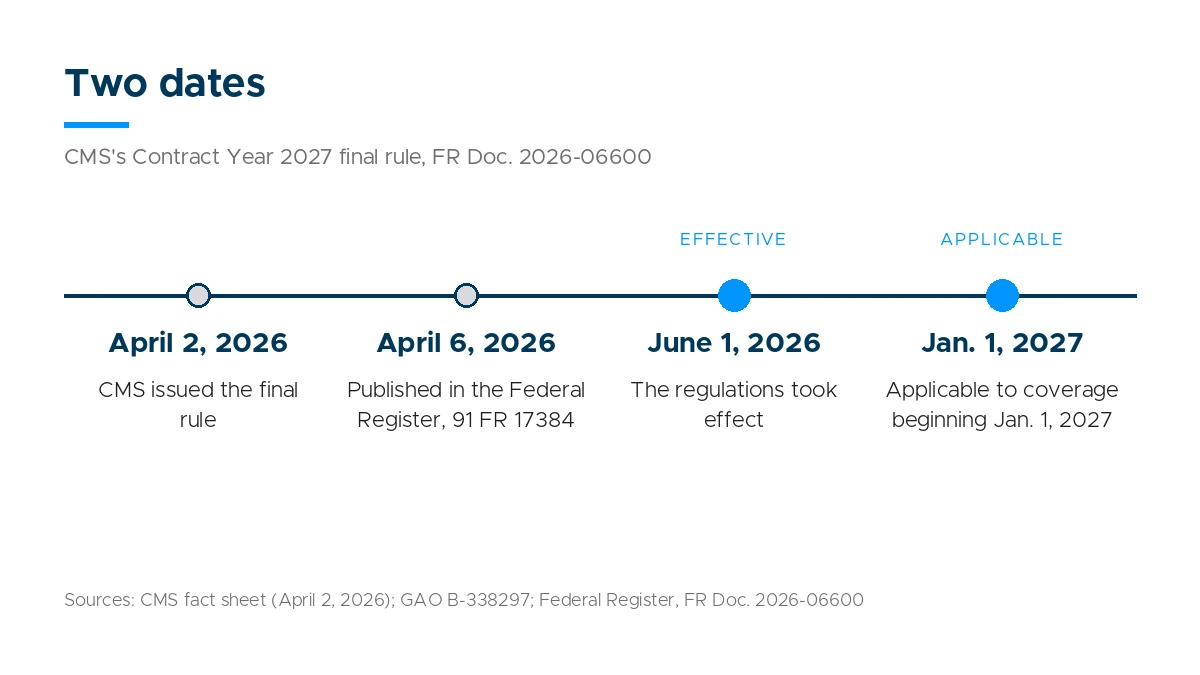
The regulations took effect June 1, 2026, and are “applicable to coverage beginning January 1, 2027,” according to the final rule in the Federal Register. The first date is when the regulations took effect; the second is when they begin to apply to coverage.
The Centers for Medicare & Medicaid Services (CMS) issued the final rule on April 2, 2026, according to its fact sheet. It was published in the Federal Register on April 6, 2026, at 91 FR 17384, according to the Government Accountability Office.
Which Medicare Advantage benefits does the rule cover?
The rule applies only where a plan uses a debit card to administer benefits, and only to two kinds of benefit: reductions in cost sharing, and 100% coverage of a mandatory supplemental benefit. CMS says “the use of debit cards to administer benefits remains voluntary for participating plans” (Table 1).
The regulation’s scope sentence reads: “MA organizations that administer reductions in cost sharing or provide coverage of 100 percent of the cost of a mandatory supplemental benefit through use of a debit card must do all of the following” (§ 422.102(g)(2)).
Optional supplemental benefits are a separate category. The regulation says they are “purchased at the discretion of the enrollee” (§ 422.102(b)), and paragraph (g)(2) does not name them. CMS’s Contract Year 2027 Part C bid guidance, dated April 22, 2026, goes further: “Debit cards may not be used to administer optional supplemental benefits” (CMS bid memo). That sentence comes from guidance, not from the regulation’s text.
What does the regulation mean by real-time verification at the point of sale?
The regulation’s words, in § 422.102(g)(2)(i), are “a real-time identification mechanism to verify eligibility of plan covered benefits at the point of sale.” In plain English, the card has to recognize, at the register, whether what is being bought is a covered benefit.
The text names no technology, no product-code standard, and no merchant list.
What else must a plan provide alongside the card?
Instructions, “customer service support,” an alternative reimbursement process, and a plan-year limit, under paragraph (g)(2)(ii) through (iv).
The alternative process must be “an alternative process that allows for reimbursement of eligible expenses for plan covered benefits in circumstances where the debit card is unusable at the point of sale, including but not limited to debit card malfunction or when a beneficiary is entitled to obtain covered benefits out-of-network.” The plan-year limit is stated in one phrase: cards must be “limited to the specific plan year.”
A general rule sits above these four. MA organizations “must have processes for delivering supplemental benefits to enrollees that ensure … appropriate access to all covered items and services” (§ 422.102(g)(1)).
Is the debit card requirement new?
Partly — and CMS describes it both ways. CMS says the provision “primarily clarifies existing guidance and expectations,” and that real-time verification and an alternate reimbursement process are practices “already widely adopted by many plans” (Table 1).
In the same row of the same table, CMS describes the provision as “codifying existing guidance on debit card administration for supplemental benefits and adding guardrails, including real-time verification mechanisms, enhanced disclosure requirements, and improved customer support.” The rule’s own sub-heading in the Federal Register is “New Guardrails for Plan Debit Cards.” CMS’s fact sheet describes the rule as “codifying and clarifying requirements for administering supplemental benefits through debit cards.”
The provision was proposed in the Contract Year 2026 proposed rule (89 FR 99340, Dec. 10, 2024) and finalized in this rule. CMS uses both descriptions, and this article does not choose between them.
Did CMS finalize everything it proposed for supplemental benefit debit cards?
No. CMS finalized the debit card proposal “with modifications, including not finalizing the proposed prohibition on marketing the dollar value of supplemental benefits” (Federal Register).
What should a supplemental benefits team check before Jan. 1, 2027?
Start with five questions about your own plan:
- Which of our Contract Year 2027 benefits are delivered by card, and are they cost-sharing reductions or mandatory supplemental benefits?
- Is any card-delivered benefit an optional supplemental benefit?
- Where do members get instructions for using the card?
- What is our reimbursement path when a card cannot be used at the point of sale?
- Are our cards limited to the plan year?
For more on supplemental benefits programs, read how Speak works with health plans, or browse more articles on the Speak Insights page.
Frequently asked questions
Does CMS’s 2027 debit card rule apply to flex cards?
The regulation doesn’t use the term “flex card.” Its requirements apply to any debit card a Medicare Advantage plan uses to administer reductions in cost sharing, or 100% coverage of a mandatory supplemental benefit, whatever the card is called (42 CFR § 422.102(g)(2)). For those cards, the requirements apply to coverage beginning Jan. 1, 2027 (Federal Register).
Do Medicare Advantage plans have to use debit cards for supplemental benefits?
No. CMS says “the use of debit cards to administer benefits remains voluntary for participating plans” (final rule, Table 1). The requirements in 42 CFR § 422.102(g)(2) apply only when a plan chooses to administer reductions in cost sharing, or 100% coverage of a mandatory supplemental benefit, through a debit card.
Can a supplemental benefit debit card be used for optional supplemental benefits?
CMS’s Contract Year 2027 Part C bid guidance, dated April 22, 2026, says “Debit cards may not be used to administer optional supplemental benefits” (CMS bid memo). That statement comes from guidance; paragraph (g)(2) of the regulation does not name optional supplemental benefits.
What happens if a member’s card doesn’t work at the register?
The plan must have an alternative process that allows reimbursement of eligible expenses when the card is unusable at the point of sale, “including but not limited to debit card malfunction or when a beneficiary is entitled to obtain covered benefits out-of-network” (§ 422.102(g)(2)).
Do supplemental benefit debit cards have to be tied to a plan year?
Yes. The regulation requires that debit cards be “limited to the specific plan year” (§ 422.102(g)(2)), applicable to coverage beginning Jan. 1, 2027 (Federal Register).
This is a summary of the regulation, not legal advice. Read 42 CFR § 422.102(g) in full.
For health plans
One wallet. Every benefit your members have earned.
See how Speak can work for your plan. Tell us about your members and benefits, and our team will follow up.